
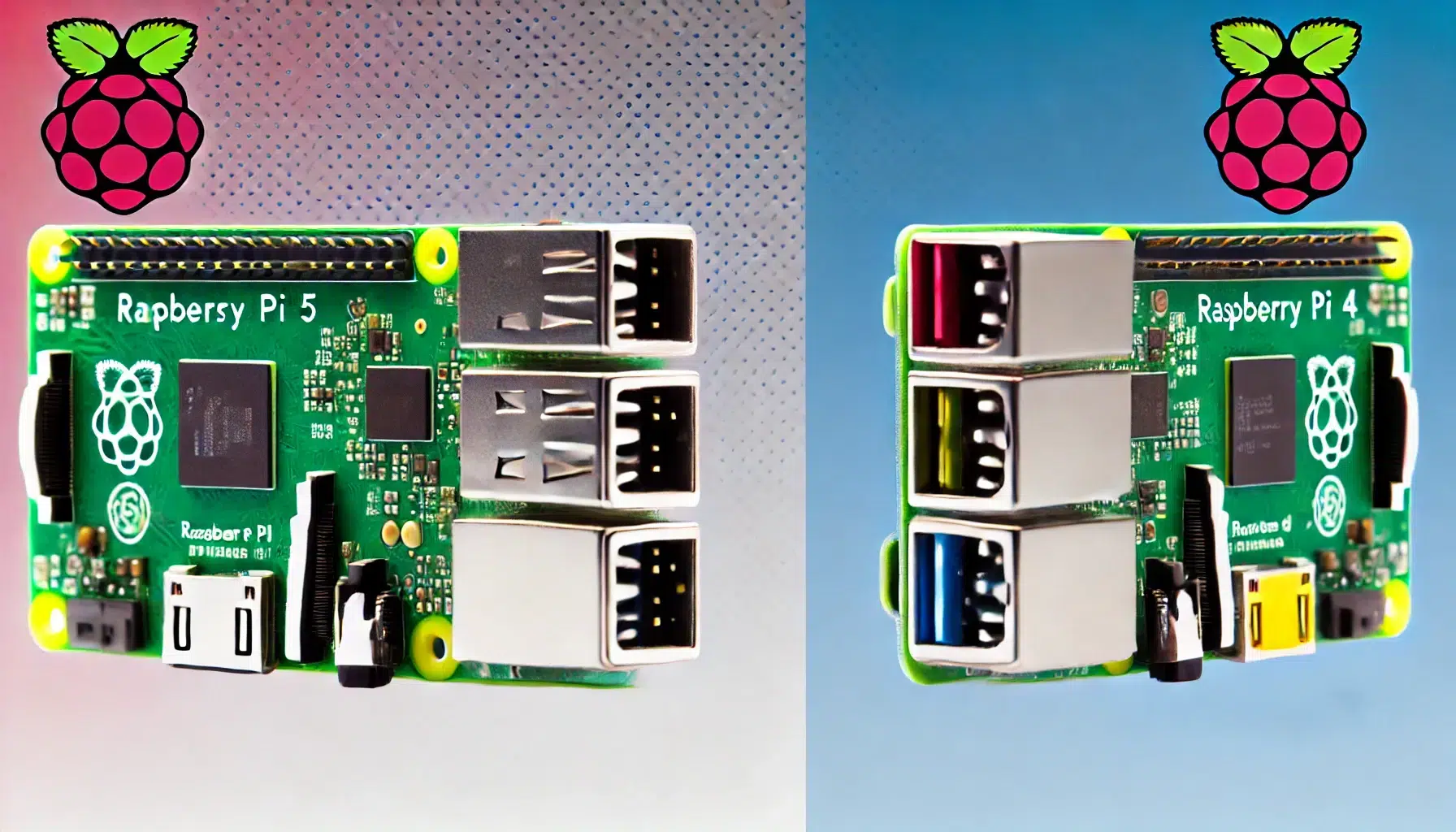
Raspberry Pi 5 vs Raspberry Pi 4: Full comparison between the two generations
Visit Raspberry Pi has long been the preferred choice of developers, educators and technology enthusiasts for a variety of projects. With the arrival of Raspberry Pi 5it's time to compare the evolutions brought by this new generation with the previous one. Raspberry Pi 4. This article provides a detailed analysis of the features, performance and potential uses of both models, to help you choose the one that best suits your needs.
Votre choix est fait ? Les cartes Raspberry Pi 4 Model B (1, 3, 4 et 8 Go) et leurs boîtiers sont en stock et expédiés sous 24/48 h depuis la France. Pour la nouvelle génération, comparez les versions et les kits sur notre page Raspberry Pi 5.
Comparison of Technical Specifications
Processor and Performance
- Raspberry Pi 4 The Pi 4 is equipped with a quad-core ARM Cortex-A72 processor running at 1.5 GHz, offering solid performance for a wide range of tasks.
- Raspberry Pi 5 The Pi 5 introduces a much more powerful processor, the Broadcom BCM2712 with a quad-core ARM Cortex-A76 clocked at 2.4 GHz. This represents a 2-3x increase in CPU performance over the Pi 4, making it an ideal option for more intensive tasks.
Memory
- Raspberry Pi 4 Available in 1GB, 2GB, 4GB and 8GB LPDDR4 RAM variants.
- Raspberry Pi 5 2GB, 4GB and 8GB LPDDR4X-4267 RAM configurations, offering higher memory bandwidth, which improves overall system performance, especially in applications requiring fast memory access.
Graphics and Display
- Raspberry Pi 4 : Equipped with a GPU VideoCore VI which supports dual 4K output at 60 fps and H.265 hardware decoding.
- Raspberry Pi 5 The GPU VideoCore VII significantly improves graphics performance with OpenGL ES 3.1 and Vulkan 1.2 support, and also handles dual 4K output at 60 fps, while offering enhanced 4Kp60 HEVC decoding.
Connectivity
- Raspberry Pi 4 Equipped with 2 USB 3.0 ports, 2 USB 2.0 ports and a Gigabit Ethernet port. It also supports Wi-Fi 802.11ac and Bluetooth 5.0.
- Raspberry Pi 5 Pi 4: Adds a PCIe 2.0 x1 slot for high-bandwidth peripherals, while retaining the same connectivity options as the Pi 4. What's more, it offers enhanced peripheral support via improved MIPI transceivers for cameras and displays.
Storage
- Raspberry Pi 4 microSD slot for operating system and data storage.
- Raspberry Pi 5 Continues with microSD slot, but now supports SDR104 high-speed mode, doubling SD card performance compared with the Pi 4.
Food and Energy Management
- Raspberry Pi 4 Powered by a USB-C port with a power requirement of 5V/3A.
- Raspberry Pi 5 : Requires a 5V/5A power supply via USB-C, but also introduces a physical power button for simpler control, as well as support for Power Delivery.
Recommended applications and uses
Educational and DIY projects
- Raspberry Pi 4 Remains an excellent option for educational projectswith sufficient power for thelearning to programelectronic prototyping, and the creation of simple servers.
- Raspberry Pi 5 Thanks to its enhanced performance, it is better suited to complex projects such as the image processingthe game developmentand the environments of virtual reality.
Home and Office Servers
- Raspberry Pi 4 : Able to manage multimedia serverfile management and light office applications.
- Raspberry Pi 5 With its improvements in computing power and connectivity, it can easily handle heavier workloads, such as hosting several virtual servers, the high-quality video streamingor virtualized desktop environments.
Industrial Applications
- Raspberry Pi 4 Used in lightweight industrial solutions, such as automation controllers or simple embedded systems.
- Raspberry Pi 5 With its PCIe interface and extensive peripheral connectivity capabilities, it is ideally suited to demanding industrial environments requiring greater reliability and flexibility.
Conclusion: Which one to choose?
The choice between Raspberry Pi 4 and the Raspberry Pi 5 depends mainly on your specific needs:
- For educational projects, simple servers and DIY projectsThe Raspberry Pi 4 remains a very capable option, especially with its economical 1GB and 2GB RAM variants.
- For more demanding projects, industrial environments or intensive useThe Raspberry Pi 5 is the best choice, thanks to its superior CPU/GPU performance, better memory management and extended connectivity.
The two models will continue to coexist, offering unprecedented flexibility and accessibility for all types of project.
