
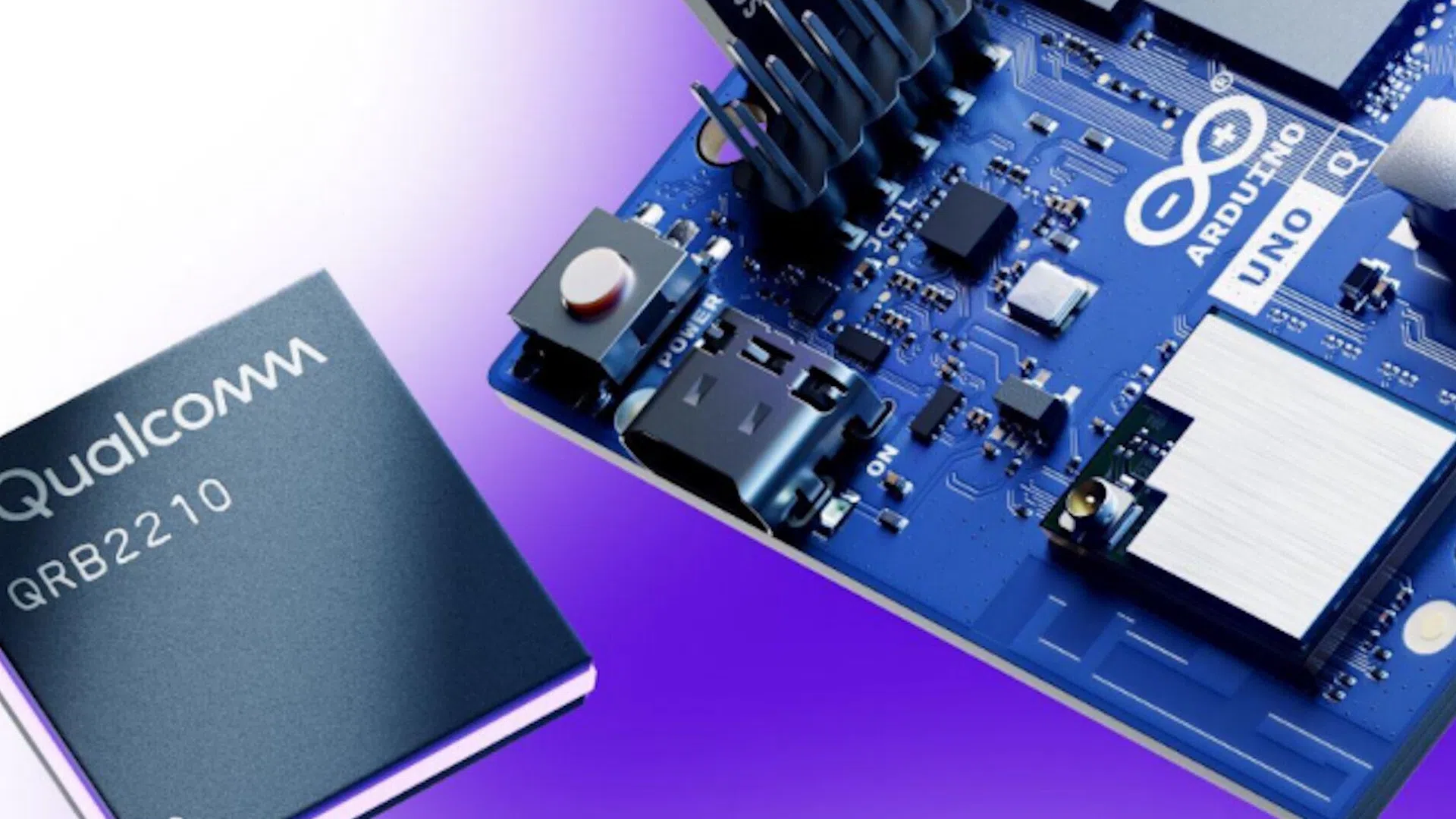
Arduino Uno Q: Arduino's new “dual brain” generation
Introduction
Arduino has just reached a milestone we had been waiting for for a long time: with theArduino UNO Q, announced at the same time as the acquisition of Arduino by Qualcomm on 7 October 2025 (amount not disclosed), the brand officially moves from a simple prototyping board to a complete edge/AI platform. The Uno Q is the first Arduino board to combine a Qualcomm Linux application processor and a real-time Arduino-compatible microcontroller in the form factor we already know. This is what Arduino calls a board with a “double brain” or « dual-brain platform ».
The message is clear: Arduino wants to stay Arduino, but with Qualcomm's networking, AI and multimedia power. For makers, teachers and IoT integrators, this is excellent news.
1. An Uno… that can run Linux
On the “high-level” side, the heart of the Uno Q is the Qualcomm Dragonwing™ QRB2210 : a quad-core SoC Arm Cortex-A53 at 2.0 GHz, with an Adreno GPU and dual ISP for video. It is the same profile Qualcomm usually reserves for its industrial or robotics embedded platforms: it runs Debian Linux, it can handle Python, Node, lightweight Docker, and it is designed for vision + audio + embedded AI applications. Arduino puts it in black and white: “it's Arduino, it's a computer, it's anything you want to build”.
This point is crucial: until now, as soon as you wanted to move towards Linux + AI + advanced connectivity, you left the Arduino ecosystem for a Raspberry Pi, a Jetson or an x86 board. Now you stay in Arduino.
2. … and a real Arduino MCU for real-time tasks
The Uno Q does not abandon what made Arduino successful: it adds an STM32U585 (Cortex-M33) dedicated to real time and classic Arduino sketches. It is the one that talks to the GPIO down to the millisecond, handles interrupts, servos and small shields, in short everything you don't want to do under Linux so as not to lose precision.
So you really have two worlds on the same board :
- Brain 1 (Qualcomm MPU) : Linux, AI, networking, camera, web services
- Brain 2 (STM32 MCU) : I/O, sensors, actuators, Arduino compatibility
The two are interconnectés (Arduino talks about an internal bridge) so that high-level code can drive the real-time side, and vice versa. This is exactly the kind of architecture that until now was found on much more expensive boards, often reserved for the industrial market.
3. Connected out of the box: Wi-Fi 5, Bluetooth 5.1, USB-C
Another long-awaited new feature: the Uno Q comes already connected. No more need to stack a Wi-Fi or BLE shield, you get as standard:
- Wi-Fi 5 dual-band,
- Bluetooth 5.1,
- USB-C with modern power delivery,
- video support via USB-C according to the profiles specified by Arduino.
For IoT projects or customer demos, it changes everything: you take the board out of the box, connect it to the network, push a web app or a local dashboard, with no additional wiring.
4. UNO compatibility (and why it is strategic)
Arduino could have said: “new board, new form factor”. They did the opposite. The Uno Q keeps the footprint and logic of the UNO family :
- familiar pinout,
- UNO shields largely reusable,
- use with Arduino IDE and Arduino Cloud inchangé.
It is a real signal sent to the community: yes, the board is more powerful, yes, there is a Qualcomm SoC, but we're not breaking your habits. For e-commerce sites (including yours), it's perfect: it can be positioned as “the new UNO”, not as an exotic board.
5. The context: Qualcomm's acquisition of Arduino
On 7 October 2025, Qualcomm officially announces the acquisition of Arduino. In its press release, the chipmaker explains that it wants to “accelerate access for Arduino's 33 million developers to its edge/AI portfolio”. Arduino, for its part, insists that:
- the brand Arduino remains,
- the community remains open,
- the support for multiple architectures remains (so no immediate Qualcomm lock-in).
This is exactly what independent analyses confirm: for Qualcomm, it is a way to enter through the front door into the world of makers, education and SMEs, a world it reaches less easily than smartphones or cars. For Arduino, it is a technological and industrial boost : access to SoCs, the manufacturing chain, the partner network.
The fact that the Uno Q was released on the same day as the acquisition announcement is anything but a coincidence: it is the showcase board of this union. It shows: “this is what we can do when we combine Arduino simplicity with Qualcomm tech”.
6. What it changes for makers (and what it doesn't)
What doesn't change:
- Arduino IDE remains the entry point,
- sketches run on the MCU,
- UNO shields remain relevant,
- open source and schematics are still published (Arduino says so on the product page).
What really changes:
- on a Linux + Arduino on the same board,
- on a embedded AI (vision, sound) with the hardware designed for it,
- on a built-in modern connectivity,
- you can aim for more professional use cases (field gateway, light robotics, demo kiosk, edge AI).
In other words, the Uno Q is not a “forced” replacement for the Uno R4: it is the new general-purpose flagship from Arduino.
7. Conclusion
L'Arduino UNO Q marks a turning point: Arduino is no longer just the brand that lights up LEDs, it is now an edge/AI platform capable of running Linux, processing images and sound, and communicating over modern networks, without giving up Arduino simplicity. The coincidence with the Qualcomm acquisition is no coincidence: it is proof that the new Arduino will be more powerful, more connected, more professional… but that it still speaks the makers' language.
