
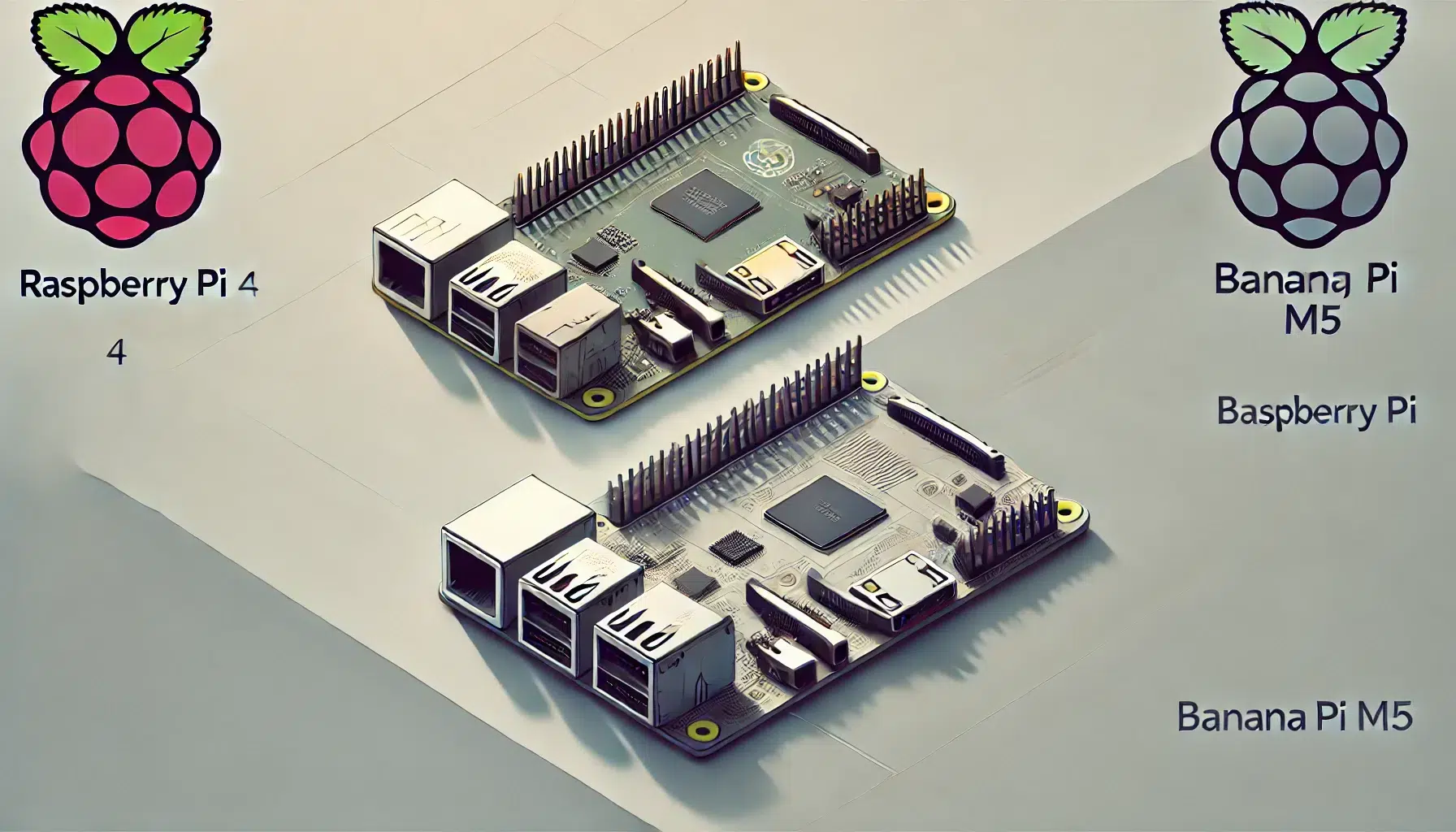
Raspberry Pi 4 Model B or Banana Pi BPI-M5: comparison
Visit Raspberry Pi and Banana Pi are popular single-board computers (SBCs) among tech enthusiasts, educators and developers. Although they share similar features, they have notable differences in terms of performance, functionality and applications.
Model comparison
Here is a detailed comparison between the Raspberry Pi 4 Model B and the Banana Pi M5, two popular models from each brand.
| Features | Raspberry Pi 4 Model B | Banana Pi M5 |
|---|---|---|
| Processor (CPU) | Broadcom BCM2711, Quad-core Cortex-A72 (ARM v8) 64-bit SoC @ 1.5GHz | Amlogic S905X3 Quad-Core Cortex-A55 (2.0GHz) |
| Random Access Memory (RAM) | 1GB, 2GB, 4GB ou 8GB LPDDR4-3200 SDRAM | 4GB LPDDR4 |
| Storage | Micro-SD card slot | 16GB built-in eMMC, Micro-SD card slot |
| Network connectivity | Wi-Fi 2.4 GHz et 5.0 GHz IEEE 802.11ac, Bluetooth 5.0, Ethernet Gigabit | Gigabit Ethernet, Wi-Fi and Bluetooth via external USB dongle |
| USB ports | 2 x USB 3.0, 2 x USB 2.0 | 4 x USB 3.0 |
| Video output | 2 x micro HDMI (up to 4Kp60 supported) | 1 x HDMI 2.0 (up to 4K@60Hz with HDR, CEC, EDID) |
| Operating system | Supports various Linux distributions, including Raspberry Pi OS, Ubuntu and more | Supports Android, Ubuntu, Debian, Raspbian |
| Where to buy? | See Raspberry Pi 4 boards | See the Banana Pi BPI-M5 |
Main differences
Performance
- CPU : The Banana Pi M5 has a Cortex-A55 processor clocked at 2.0GHz, the Raspberry Pi 4 a Cortex-A72 at 1.5GHz. Frequency alone does not allow the two to be compared: they are different architectures.
- RAM : The Raspberry Pi 4 offers more flexible memory options, from 1GB to 8GB, while the Banana Pi M5 is limited to 4GB.
Storage
- Raspberry Pi 4 : Mainly uses Micro-SD cards for storage, with the option of adding an external SSD via the USB ports.
- Banana Pi M5 : Integrates 16GB of eMMC storage, offering higher read/write speeds and better durability than Micro-SD cards.
Connectivity
- Raspberry Pi 4 : Has built-in dual-band Wi-Fi and Bluetooth 5.0, making wireless connections easy.
- Banana Pi M5 : Has no built-in wireless connectivity; requires external USB adapters for Wi-Fi and Bluetooth.
USB ports
- Raspberry Pi 4 : Offers two USB 3.0 ports and two USB 2.0 ports.
- Banana Pi M5 : Provides four USB 3.0 ports, enabling faster data transfers for several peripherals simultaneously.
Community and support
- Raspberry Pi : Benefits from a vast global community, offering a multitude of resources, tutorials and projects.
- Banana Pi : Has a smaller community, which may limit access to extensive resources and support.
Recommended use cases
- Raspberry Pi 4 : Ideal for projects requiring built-in wireless connectivity and memory flexibility, and benefiting from the support of a large community.
- Banana Pi M5 : Suitable for applications requiring fast built-in storage and plenty of USB 3.0 ports.
Conclusion
The choice between the Raspberry Pi 4 and the Banana Pi M5 depends mainly on your specific needs in terms of performance, connectivity and community support. The Raspberry Pi 4 offers memory flexibility and built-in wireless connectivity, backed by an active community. The Banana Pi M5 stands out for its built-in eMMC storage and additional USB 3.0 ports, although it requires external adapters for Wi-Fi and Bluetooth.
Before making your choice, carefully assess your project’s requirements in order to select the SBC best suited to your needs.
Raspberry Pi or Banana Pi? The Raspberry Pi retains the advantage of an operating system maintained by the manufacturer and a very large community. Banana Pi boards stand out above all for networking: discover our range of Banana Pi and our Raspberry Pi 4 boards.
