
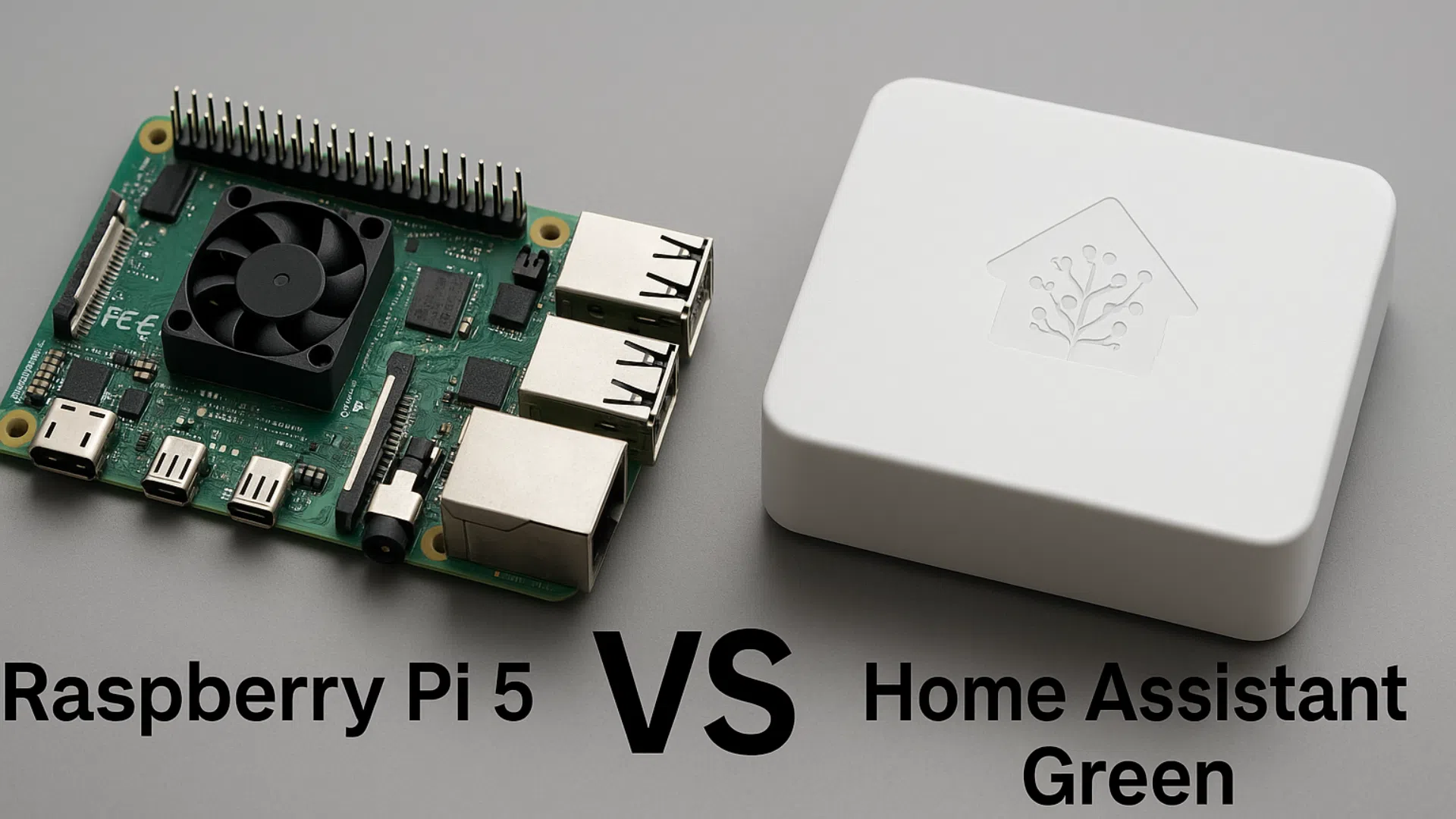
Raspberry Pi 5 vs Home Assistant Green: which one to choose for home automation?
Introduction
Home automation is winning over more and more users, whether they're passionate about new technologies or simply want to make their home smarter. Two solutions are attracting particular attention: the Raspberry Pi 5 and the Home Assistant Green.
The first is a versatile nanocomputerultra-customizable and affordable, while the second is a turnkey devicespecifically designed to run Home Assistant without any headaches.
So which one should you choose? Here's one detailed comparison to help you make the right decision.
1. Quick overview
Raspberry Pi 5
The Raspberry Pi 5 is the new generation of the famous compact motherboard. It features :
- A processor quad-core ARM Cortex-A76 at 2.4 GHz.
- A GPU VideoCore VII more powerful.
- From 4, 8 or 16 GB LPDDR4X RAM depending on the model.
- The possibility of using a SSD NVMe via PCIe slot.
Simply put, it's a little power bomb in a small package.
Home Assistant Green
The Home Assistant Green, on the other hand, is a device designed exclusively for home automation. It includes :
- A processor quad-core ARM at 1.8 GHz.
- 4 GB RAM.
- 32 GB eMMC storage in-house.
- Ready-to-use design: plug in, start up, configure your connected home.
2. Easy to set up
- Home Assistant Green the big advantage is its plug-and-play simplicity. Just plug in the device, access the interface, and Home Assistant is ready to go. No technical knowledge is required.
- Raspberry Pi 5 you have to install it yourself Home Assistant OS (or another method), prepare the SD card or SSD, connect the accessories... In short, a little more work and technical know-how.
👉 Verdict: advantage to Home Assistant Green for beginners.
3. Customization and scalability
- Raspberry Pi 5 This is the realm of the maker. You can choose the operating system, add an SSD, connect sensors via GPIO pins, use the Pi for other projects (multimedia server, retro console, mini-cloud, etc.). Its unrivalled versatility.
- Home Assistant Green It's designed exclusively for Home Assistant. No internal hardware upgrades. Its vocation is clear: to be a reliable home automation box, and nothing else.
👉 Verdict: advantage to the Raspberry Pi 5 for tinkerers and enthusiasts.
4. Performance and fluidity
- Raspberry Pi 5 Thanks to its more powerful processor and available RAM of up to 16 GB, it can handle much more than just Home Assistant. Complex automation, integration of multiple devices and even parallel services (such as a media server or database) work perfectly.
- Home Assistant Green Designed exclusively for Home Assistant, it is optimized for this role. Even with "only" 4 GB of RAM, the experience remains fluid and stable to manage classic home automation.
👉 Verdict: a tie, with a slight Pi 5 advantage for the multi-use projects.
5. Energy consumption
- Raspberry Pi 5 Power consumption: modest (between 3.5 and 5 W on average), but a little higher than previous generations of Raspberry Pi. Over the year, this is still very low, but you have to add the consumption of an SSD or accessories.
- Home Assistant Green designed for sobriety, it generally revolves around 2 to 3 W for standard use. Ideal for a machine that will be on 24/7.
👉 Verdict: advantage to Home Assistant Green, more thrifty.
6. Price and accessibility
- Raspberry Pi 5 The 8 GB version is generally available for around €80. But don't forget to add: official power supply, case, SD card or SSD. The whole package quickly rises to around €110-130.
- Home Assistant Green For around €99, everything is included in a compact case. No need to buy anything else (except home automation accessories).
👉 Verdict: advantage to Home Assistant Green for the price/simplicity ratio.
7. Target audience
- Home Assistant Green ideal for beginners, families and non-technical users. If your aim is only to control your home with Home Assistant, without taking care of the rest, this is the best solution.
- Raspberry Pi 5 for makers, tech enthusiasts and tinkerers. If you want to experiment, add other uses in addition to home automation, and retain great flexibility, the Pi 5 is for you.
Quick comparison chart
| Criteria | Home Assistant Green | Raspberry Pi 5 |
|---|---|---|
| Easy to install | ⭐⭐⭐⭐⭐ (ready-to-use) | ⭐⭐ (manual configuration) |
| Scalability | ⭐⭐ (limited) | ⭐⭐⭐⭐⭐ (very high) |
| Performance | ⭐⭐⭐⭐ (optimized) | ⭐⭐⭐⭐⭐ (powerful and versatile) |
| Consumption | ⭐⭐⭐⭐⭐ (2-3 W) | ⭐⭐⭐⭐ (3,5-5 W) |
| Total price | ⭐⭐⭐⭐⭐ (€99 all-inclusive) | ⭐⭐⭐ (80 € + accessories) |
| Target audience | Beginners / Simplicity | Passionate / Versatile |
Conclusion
The choice between Raspberry Pi 5 and Home Assistant Green depends above all on your needs:
- You want a solution simple, ready-to-use, economical and energy-efficient ? → Home Assistant Green is the best choice.
- You are curious, technophile, and looking for a multi-purpose, upgradeable and powerful device ? → Raspberry Pi 5 will be more suitable.
In fact, both solutions are excellent. One is aimed at easy and the peace of mindthe other the flexibility and the infinite potential.
👉 It's up to you: do you prefer a ready-to-use home automation tool or a miniature technology laboratory for all your projects?
